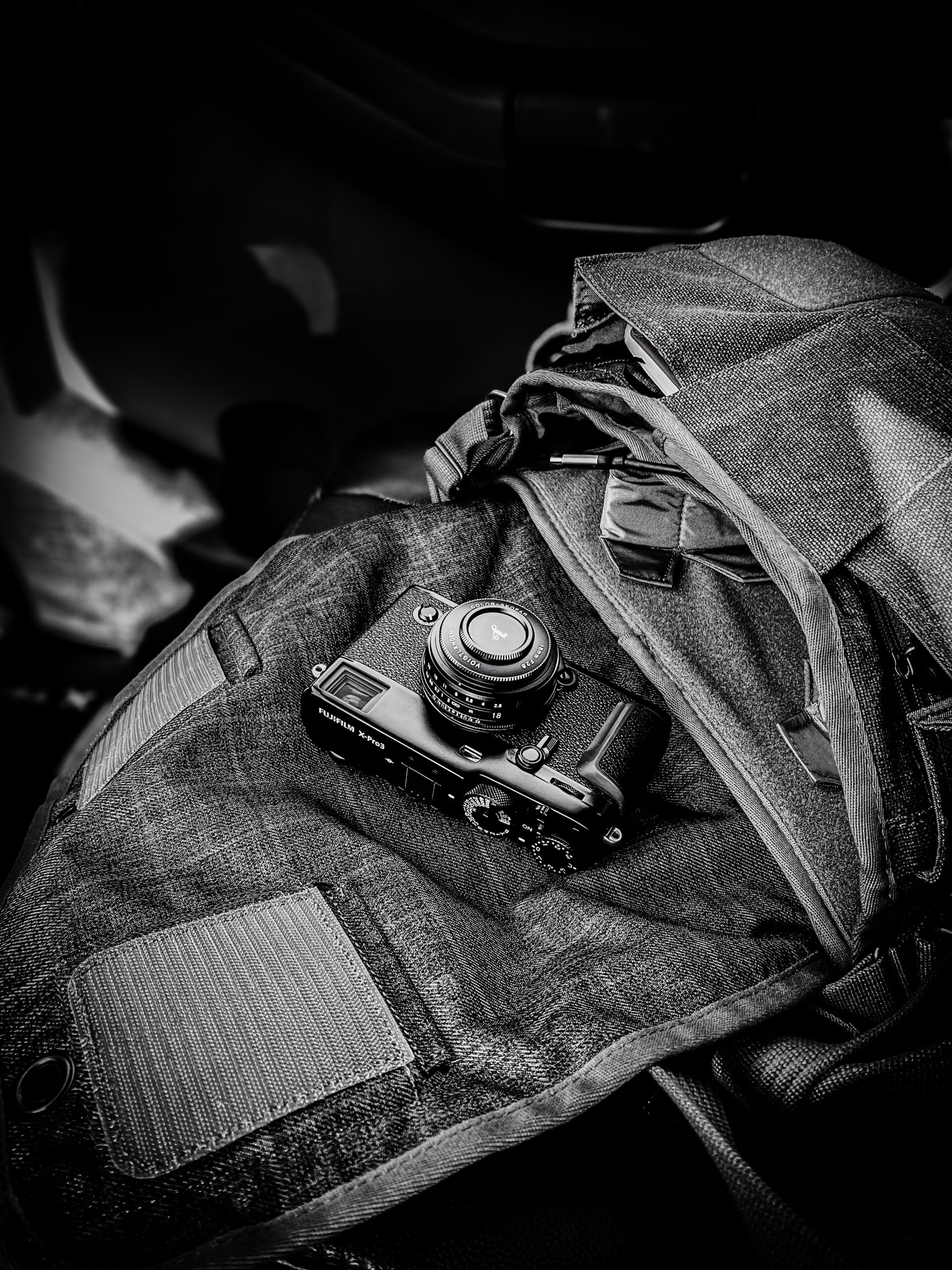
Written in September 2026, nearly seven years after its release.
Fujifilm X-Pro3 in 2026: Still the Camera That Makes You Look
I’ve shot Fujifilm for more than fifteen years, ever since the original X100 landed in my hands in 2011. One thing has never changed: the color. Before I talk about sensors, megapixels, or autofocus, I always come back to how Fuji understands color and contrast. The X-Pro3 confirms that feeling, and it also brings me back to something I know well: the way of shooting from the analog era.
Coming back to analog
Inside, the X-Pro3 is essentially an X-T3 with a different personality: a 26-megapixel fourth-generation X-Trans sensor and the X-Processor 4. But what defines it is a bold decision: hiding the screen.
The rear display is folded inward, and you have to flip it down 180° to use it. In its place sits a small panel that can show your exposure settings or a reminder of the active film simulation, like the tab of a film box slipped into the back of an analog camera. For many people that’s a provocation. For me, coming from analog photography, it’s wonderful.
Without a screen there’s no chimping, that habit of checking every frame right after you take it. You look through the viewfinder, shoot, and stay in the scene, not quite knowing what you have until later, the way it felt waiting for the film to be developed. That a digital camera today brings me back to that way of working feels like a tremendous win.
Light, powerful, and discreet
Another thing I value a lot is its weight. It’s around half a kilo with battery and card, and it’s still powerful, with a top-tier sensor and processor. That combination makes it far more versatile for street photography: you can carry it all day without fatigue and react quickly.
And there’s something just as important to me: it isn’t an intimidating camera for the person being photographed. Its classic rangefinder design and compact size look more like a camera from another era than a heavy professional rig. People in front of it feel more at ease, and you can see it in the photos, especially on the street and in spontaneous portraits.
The color, once again
This is where I stay. Fuji’s film simulations remain the best thing the brand does, and the X-Pro3 added a new one: Classic Neg. Its palette recalls consumer color negative film: shadows with some weight, slightly muted greens, and warm tones with character. It doesn’t try to be obviously pretty, and that’s exactly why it works.
Then there are the lenses. Fujinon optics have a contrast and color rendering that, to me, are part of the camera’s identity. The files come out clean and rich in color, and after so many years with Fuji, it still surprises me.
What it does well
- Build. The top and bottom plates are titanium. It feels solid, with a tactility that plastic or magnesium bodies can’t match. The Dura versions, with their exceptionally scratch-resistant finish, are made for carrying every day without babying them.
- Hybrid viewfinder. Still the most special thing about the X-Pro line. Switching between the optical finder with frame lines and the electronic one depending on the situation is a real advantage, and seeing what’s happening outside your frame helps enormously on the street.
- Autofocus. It was a clear step up from the X-Pro2, with a low-light range reaching down to about –6 EV.
- Useful extras. In-camera HDR, advanced multiple exposures, and clarity and tone-curve adjustments that let you refine the JPEG before you shoot.
What doesn’t convince me
No camera is perfect:
- The hidden screen divides opinion, understandably. If you want to review a frame calmly, the flipped-down screen works, but it isn’t comfortable.
- The d-pad is gone. Its job moved to the joystick, which takes some adjustment.
- The grip is modest. With big, heavy lenses, shooting vertically gets uncomfortable.
- No in-body stabilization, something many people now take for granted.
- The viewfinder is small, and the launch price was steep: in Europe, about €1,900.
- Video takes a back seat. This is a stills camera, and it should be treated as one.
Shooting the X-Pro3 in 2026
The obvious question today is whether a camera announced in 2019 still makes sense. My answer is yes, with conditions.
What hasn’t aged. The color science, the film simulations, the hybrid viewfinder, the titanium build, and above all the philosophy. The 26MP sensor still produces excellent files, and a camera that pushes you to get things right in-camera feels more relevant now, when so many bodies compete on specs, than it did at launch.
What has aged. Autofocus is the clearest gap. Next to the latest bodies with AI-based subject detection, the X-Pro3’s system feels a generation behind. It’s still perfectly usable, and a simple workaround is to focus with a single point near the center, lock focus, and recompose. There’s also no in-body stabilization, and battery life is modest, roughly 260 to 440 shots depending on how you use the display, so a spare battery makes sense.
The market. Almost seven years on, Fujifilm hasn’t announced a direct successor, as far as I can tell. Rumors of an X-Pro4 circulate, and some place it in 2027, but nothing is official. Meanwhile, used X-Pro3 prices have stayed surprisingly high: depending on condition and finish, reports put good used bodies somewhere around $1,200 to $1,750, with Dura versions commanding more, and some listings have even matched or beaten the original launch price. Check current prices before you decide, and pay attention to condition and completeness.
My verdict for 2026. If you’re drawn to a viewfinder-first way of shooting, the X-Pro3 is still a joy, and a camera that doesn’t lose its appeal over time. If your priority is the best possible autofocus, stabilization, video, or the best value per dollar, there are better options today, and waiting for a possible successor is a reasonable choice. The X-Pro3 isn’t a camera you buy because of a spec sheet. You buy it because of how it makes you work.
Who is it for?
The X-Pro3 is for photographers who already know how they want to shoot and want a tool that supports them rather than distracts them. It suits street, reportage, and documentary work, especially for people who enjoy working with few controls and many decisions of their own. It isn’t for those who want the most versatile video camera, or who need to review every frame on the go.
For me, after more than fifteen years with Fuji and with analog photography in my history, it’s a camera you think with before you press the shutter, and it brings me back to that way of seeing. And in 2026, that’s worth a lot.
author: Javier Ramíre-Carril