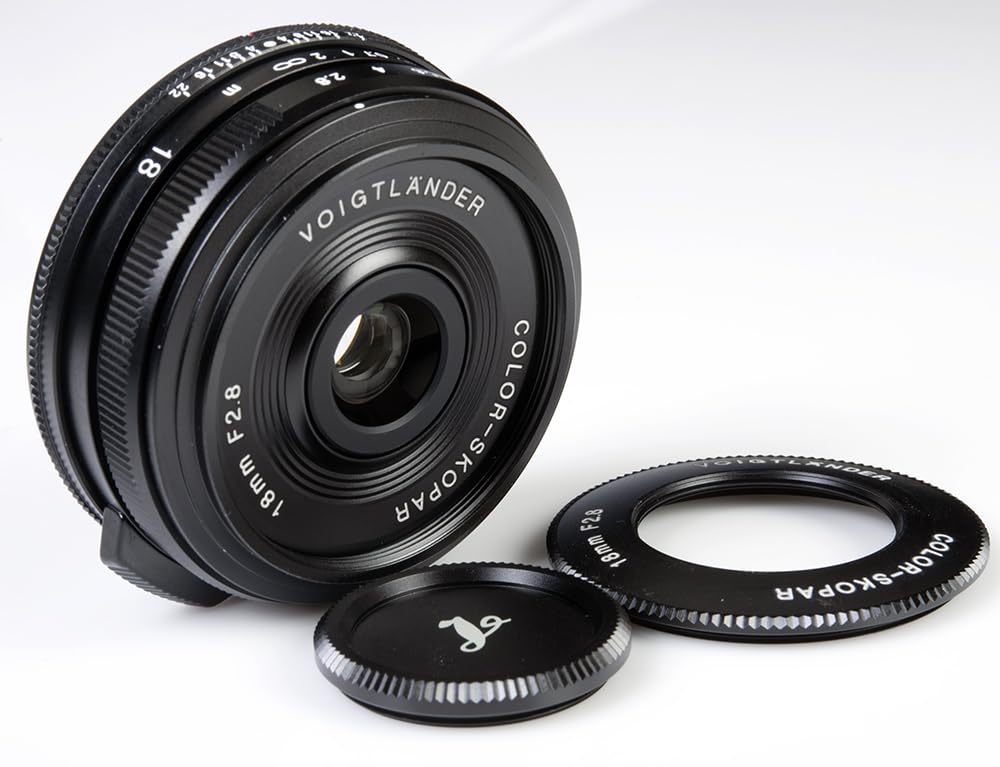
Voigtländer Color-Skopar 18mm f/2.8 for Fujifilm X: Small, Manual, and Great Value
My experience with this lens has been good, and I think it’s worth explaining why. It isn’t the most spectacular lens in the Fuji system, but it’s one of those you end up leaving on the camera all the time.
A 28mm equivalent in a tiny package
On Fujifilm APS-C sensors, 18mm is equivalent to 28mm on full frame, a very popular focal length for street and reportage because it takes in context without distorting too much. The Color-Skopar is a manual-focus lens designed by Voigtländer specifically for the X mount and introduced in early 2024.
What stands out most is its size. It’s a pancake-style lens about 23.5 mm long and around 115 g, with an all-metal build. Mounted on an X-Pro3 or X-Pro2, it almost disappears, and that changes how you carry the camera: it fits in a big pocket, weighs almost nothing, and doesn’t draw attention. For me, that size is one of its best qualities.
On the street
For street photography it works very well. The focus ring has a small tab that helps you turn it without looking, and the aperture ring moves in clear, precise third-stop clicks. If you come from analog photography or rangefinder cameras, it feels familiar: distance scale, zone focusing, and a lens that handles almost intuitively.
Another plus is its minimum focusing distance of just 17 cm, which lets you get very close when the scene calls for it. It also has a 43 mm filter thread, the same as several compact Fujinon lenses, and comes with a screw-in hood.
Image quality and color
I’ll be honest here: the colors this lens produces are good, but not extraordinary. I don’t say that as a criticism, because for what it costs it’s an excellent option. Not every lens has to be spectacular at everything, and this one delivers very well on what it promises.
Other users and reviews agree on several points: good contrast, sharpness that improves considerably when stopped down, little vignetting, well-controlled aberrations for its size, and attractive sunstars at small apertures. Its optical design of seven elements in five groups includes a double-sided aspherical element and anomalous partial dispersion glass, and its ten aperture blades give pleasant background blur, although for very soft backgrounds the Fujinon XF 18mm f/2 does it slightly better.
Value for money
With a recommended launch price of $504 and availability in black and silver, it offers a lot for the money. It’s smaller and more carefully built than most alternatives in its range, and it has been seen on the used market for noticeably less. Check the current price before buying, since it varies by country and condition.
What to keep in mind
- Manual focus. With no autofocus, it isn’t a lens for everything. If you photograph running kids or need to react quickly, an autofocus lens is more practical. For the street, with zone focusing and a bit of practice, it works very well.
- Maximum aperture f/2.8. It’s slower than the Fujinon 18mm f/2, so in low light you’ll need to raise the ISO.
- Electronic communication. It has contacts that pass EXIF data, focus aids, and distance information, but the integration is better on newer Fuji bodies. With older generations, such as the X-Pro2, some owners report more limited communication.
- X-Pro optical viewfinder. Reports about how the 18mm frame lines behave in the X-Pro3’s optical viewfinder are contradictory: some users say they adjust and others say they don’t. It’s worth testing on your own camera. The electronic viewfinder always works.
My conclusion
It’s a small, well-built, well-priced lens, ideal for anyone shooting street with an X-Pro3 or X-Pro2 who values comfort and handling over optical perfection. Its colors don’t wow me, but everything else convinces me: its size, its feel, its price, and how well it pairs with these cameras. It’s a very practical lens that, for me, more than delivers.